 Where Curiosity meets Cosmos
How do rockets, satellites and the universe really work?
Short, fun video lessons in plain language for kids aged 10–16, from a balloon on a string to Chandrayaan-3 and Starship. Made in Bengaluru, for curious kids and the parents who want to give them a head start.
Online course launching soon. School and camp programs running now.
For parents
Why space, and why now?
Space is the most exciting way into science we know. It also matters more for India every year.
India is a space nation now
ISRO landed Chandrayaan-3 near the Moon's south pole in 2023, and since 2020 private Indian companies can build rockets and satellites too. Our kids are growing up in the middle of it.
Science that finally clicks
Newton's laws, gravity and energy make sense when you see them launch a rocket. Space turns school physics, maths and coding into something kids want to understand.
Careers far beyond astronaut
Engineers, data scientists, doctors, designers and founders all work in space today. We show kids the real jobs and the skills they can start building now.
Curiosity that lasts
Every lesson starts with a question and ends with a new one. Kids learn to ask "why?" and work things out, a habit that helps in every subject.
The course
Nine learning tracks, 100 lessons
Self-paced, recorded lessons grouped into tracks. Start anywhere; each track builds from the basics.
Track 120 lessonsRocketry Basics
How a rocket actually works, from a balloon on a string to reaching orbit.
See lessons ↓
- What actually is a rocket? Pushing gas back to go forward
- Newton's third law with a balloon
- Why a rocket doesn't need air to push against
- Thrust vs weight: the one comparison that decides liftoff
- Fuel and oxidiser: why rockets carry their own "air"
- Solid vs liquid fuel rockets: the firecracker vs the gas stove
- Why rockets are mostly fuel (about 90% of their weight)
- Escape velocity: 11.2 km/s, explained with a ball throw
- Orbit = falling around the Earth and always missing
- Why rockets go up and then tilt sideways
- Staging: why rockets throw parts of themselves away
- Why launch from the coast, not the centre of a country
- Why launch sites are near the equator (Earth's free spin boost)
- Why Sriharikota? India's launch site explained
- Why rockets are tall and thin
- Max-Q: the most dangerous seconds of a launch
- Why rockets are white (and some aren't)
- What the countdown really checks
- Launch windows: why you can't launch whenever you want
- The rocket equation in plain words: more fuel needs more fuel
Track 210 lessonsRocketry Through History
From Tipu Sultan's rockets to the Saturn V, and what every failure taught us.
See lessons ↓
- Tipu Sultan's Mysorean rockets
- Tsiolkovsky: the schoolteacher who dreamed of space
- Goddard's first liquid-fuel rocket
- From war rockets to space rockets
- Sputnik: the beeping ball that started the space race
- Saturn V: the giant that took humans to the Moon
- The Space Shuttle: reusable, but very expensive
- Why rockets stayed throw-away for 60 years
- Famous failures and what they taught us
- Humanity's rocketry scorecard: where we stand today
Track 310 lessonsReusability and Starship
Rockets that land themselves, tower catches, and why cheap launches change everything.
See lessons ↓
- Why reusing rockets changes everything (the airplane analogy)
- Falcon 9 landing itself: how a rocket comes back
- Starship: the biggest rocket ever built
- Catching a rocket with chopsticks: the tower catch
- Full reusability: how close are we?
- Refuelling in orbit: a petrol pump in space
- Methane fuel: why it matters for Mars
- Raptor engines in simple words
- How cheap launches open space to everyone
- Old rockets vs Starship: side by side
Track 410 lessonsIndia in Space
Rocket parts on a bicycle to Chandrayaan-3: the story of ISRO.
See lessons ↓
- Vikram Sarabhai and ISRO's humble beginnings
- Rocket parts on a bicycle: India's first launch
- PSLV: India's workhorse
- GSLV and the cryogenic engine story
- Chandrayaan-1: water on the Moon
- Chandrayaan-3: landing near the lunar south pole
- Mangalyaan: Mars on a small budget
- Aditya-L1: India watching the Sun
- Gaganyaan: Indians in Indian rockets
- Why space programs matter for a country like India
Track 510 lessonsSatellites and Everyday Life
GPS, NavIC, weather warnings, TV and internet: the space tech you use every day.
See lessons ↓
- What is a satellite and how does it stay up?
- GPS: how your phone knows where you are
- NavIC: India's own navigation system
- Weather satellites and cyclone warnings
- Communication satellites: TV, internet, calls
- Geostationary orbit: the satellite that never moves
- Starlink and internet from space
- Space junk: the traffic jam above us
- Satellites for farmers, fishermen and disasters
- A day without satellites
Track 610 lessonsHands-On: Play and Build
Learn rocketry by playing simulators, then build bottle and paper rockets at home.
See lessons ↓
- Learn rocketry by playing: an intro to Kerbal Space Program
- Space Flight Simulator on your phone
- Build your first rocket in a game: three rules
- Why your game rocket keeps flipping (and the fix)
- Reaching orbit in a game: the gravity turn
- Water bottle rocket at home
- Paper rockets: a classroom activity
- Balloon rocket races
- Spot the ISS from your terrace
- Free space apps every kid should try
Track 710 lessonsCareers, Startups and Getting Ready
Space jobs beyond astronaut, Indian space startups, and skills to start building now.
See lessons ↓
- Jobs in space: it's not just astronauts
- Rocket and satellite engineers: what they actually do
- Space scientists and space doctors
- Skills kids should start now: maths, coding, curiosity
- Three paths into space: ISRO, a private company, or your own startup
- India opened space to private companies: what changed and why it matters
- Indian space startups: Skyroot, Agnikul, Pixxel and more
- The businesses behind a rocket: parts, materials, electronics and testing
- Space businesses on the ground: selling satellite data for farms, maps and weather
- Start small: student satellites, space clubs and camps
Track 810 lessonsThe Scale of the Universe
How big is everything, really? Light-years, Voyager and the Pale Blue Dot.
See lessons ↓
- How big is the Earth, really?
- The Moon: just next door
- The solar system to scale (a football-field model)
- A light-year in simple words
- The nearest star: how far is Proxima Centauri?
- Our galaxy: 100 billion suns
- The Pale Blue Dot: why our name matters
- What is reachable, and what isn't
- Voyager: the farthest human-made object
- Looking back in time: starlight is old light
Track 910 lessonsLimits, Sci-Fi and the Future
Warp drives, radiation, Moon bases and terraforming Mars: what's science and what's fiction.
See lessons ↓
- What stops us from going farther?
- Why Star Wars-style travel isn't possible (yet)
- Warp drive and wormholes: science or fiction?
- Radiation: the invisible danger in space
- Living on the Moon: bases and lunar ice
- Terraforming Mars: can we make it Earth-like?
- Terraforming the Moon: possible or not?
- Growing food in space
- A day in the life of a Mars settler
- Humanity's next 50 years in space
How it works
Watch, do, ask, earn
Watch
Short, animated video lessons in plain language. Our Instagram reels are the trailers.
Do
An activity sheet and a quick quiz with every lesson, from paper rockets to spotting the ISS.
Ask
A kid-safe AI space guide answers follow-up questions and nudges kids to think first.
Earn
A certificate for every completed track. Parents can see what their child is learning and asking.
Try it free
Ask our space guide anything
A taste of the question guide inside the course. It explains in simple words, uses examples kids know, and often asks them to guess first, because thinking it through is how learning sticks.
- ✓ Stays on space and science topics
- ✓ Honest when something isn't known yet
- ✓ No ads, no tracking, no sign-up needed
Ask anything about rockets, planets, satellites or space. Try one of these:
Answers come from AI and can sometimes be wrong. Please don't type your name, school or other personal details. Questions are saved without any names to help us decide which lessons to make first.
On Instagram
A new space reel every day
One idea, under a minute. Follow @beyondthebluedot for the free reels that become full lessons here.
Meet your guide
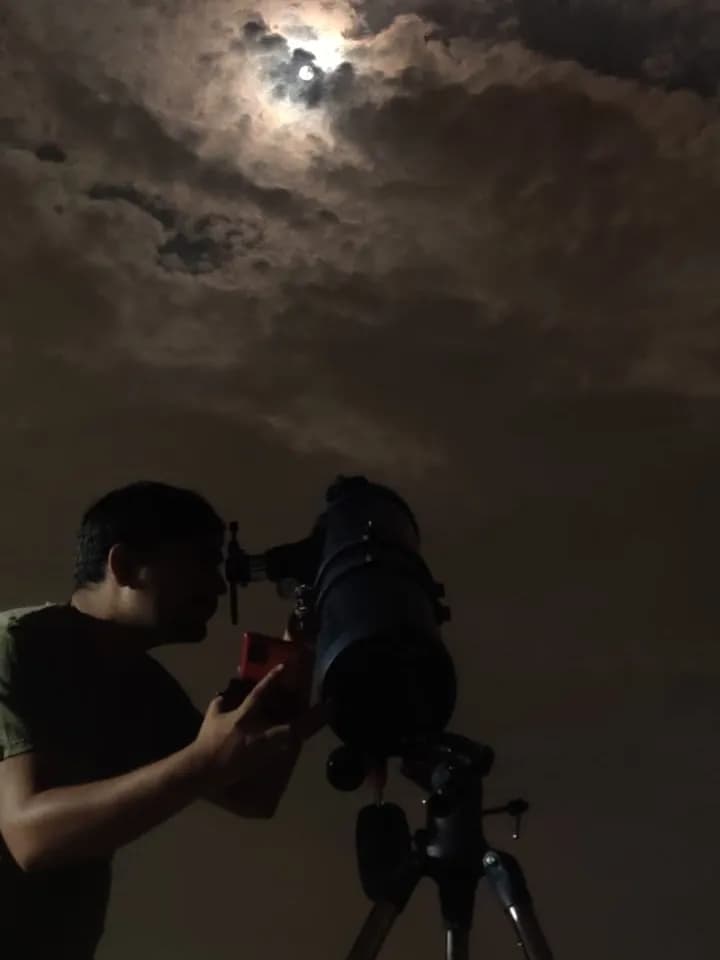
It started with a humble handycam
“A small town, a humble handycam, and a mesmerising glimpse of the Moon and Saturn. That's where my journey to the stars began.”
Coding and virtual reality became my bridge, linking my career with my passion for astronomy. Through close to a decade of running an enterprise web application business, my love for astronomy and space only grew.
Beyond the Blue Dot is where that passion turned into reality: sessions where families look through real telescopes, simulate missions like Chandrayaan-3, and go home with more questions than they came with.
Nikhil Joshi · Founder, Beyond the Blue Dot
“The sky is not the limit; it's where your story with the stars begins.”
Since 2023
Real sessions, real sky
Before the course came the sessions: online and in person, for families, apartment communities and curious grown-ups in Bengaluru. Here's what we've run so far.
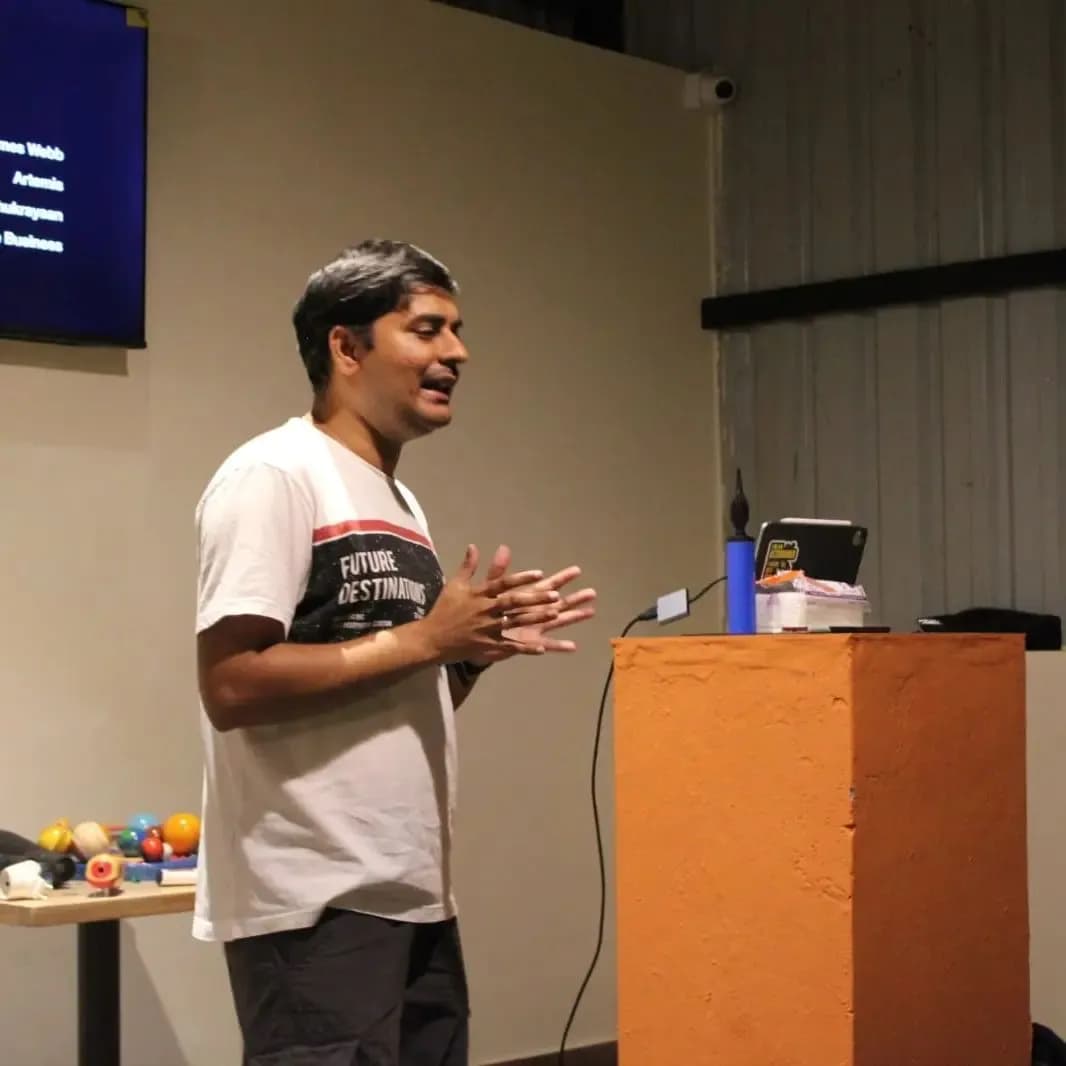
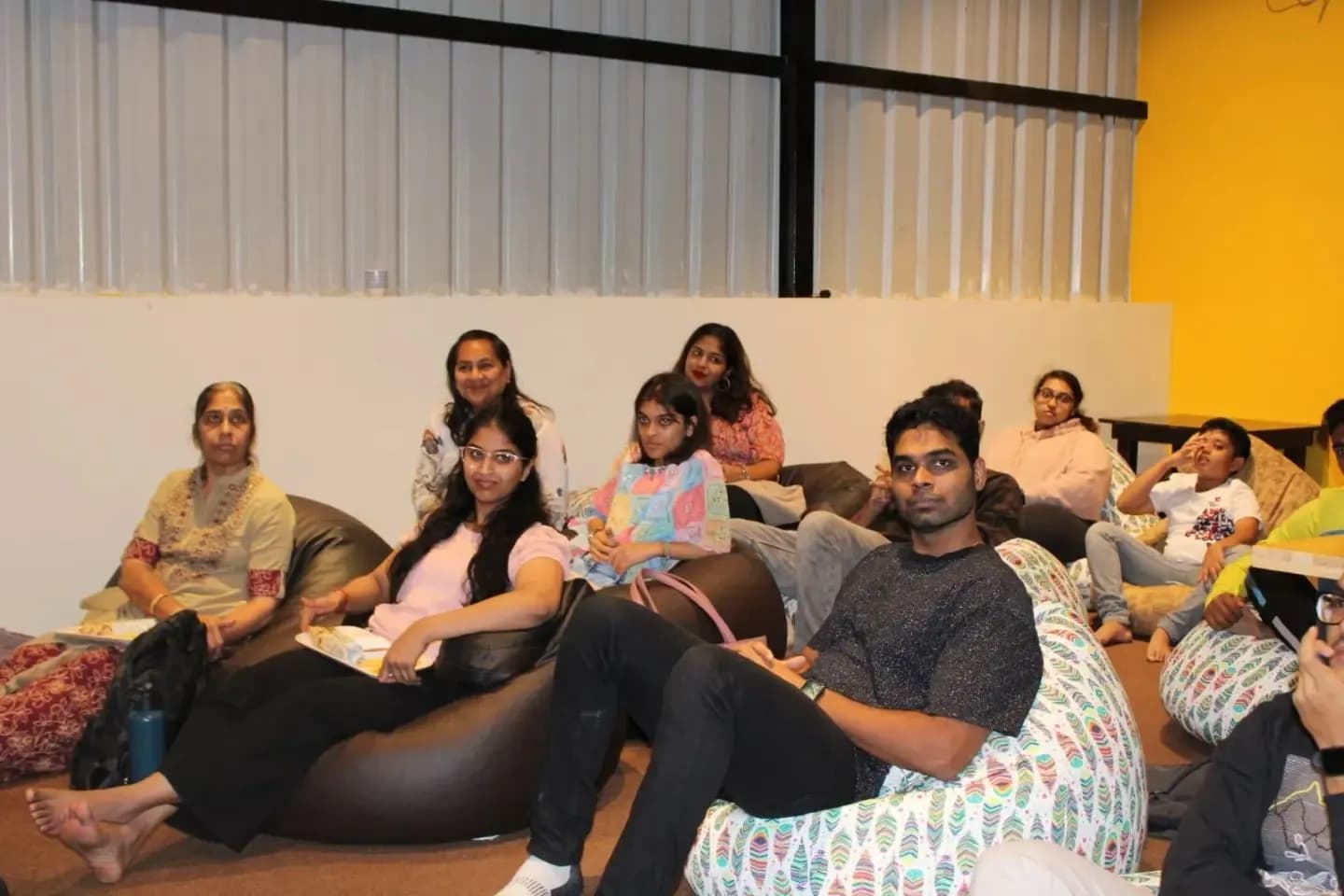
Apr 2023· 5 evenings online + a telescope night
Skyward Bound
"Let us understand the sky above and be part of it." Earth and time zones, seasons and festivals, stars and constellations, the Moon and our calendars, and how to start skywatching. Parents and kids together.
2023· In person
Cosmic Chronicles
An immersive journey from the Big Bang to space tourism, with a party-popper Big Bang and the night sky live on screen.
Jun 2023· Online
Exploring the sky with free apps
How to use Stellarium and Solar System Scope on a phone, tablet or computer to find your way around the sky.
Jul–Aug 2023· In person + online
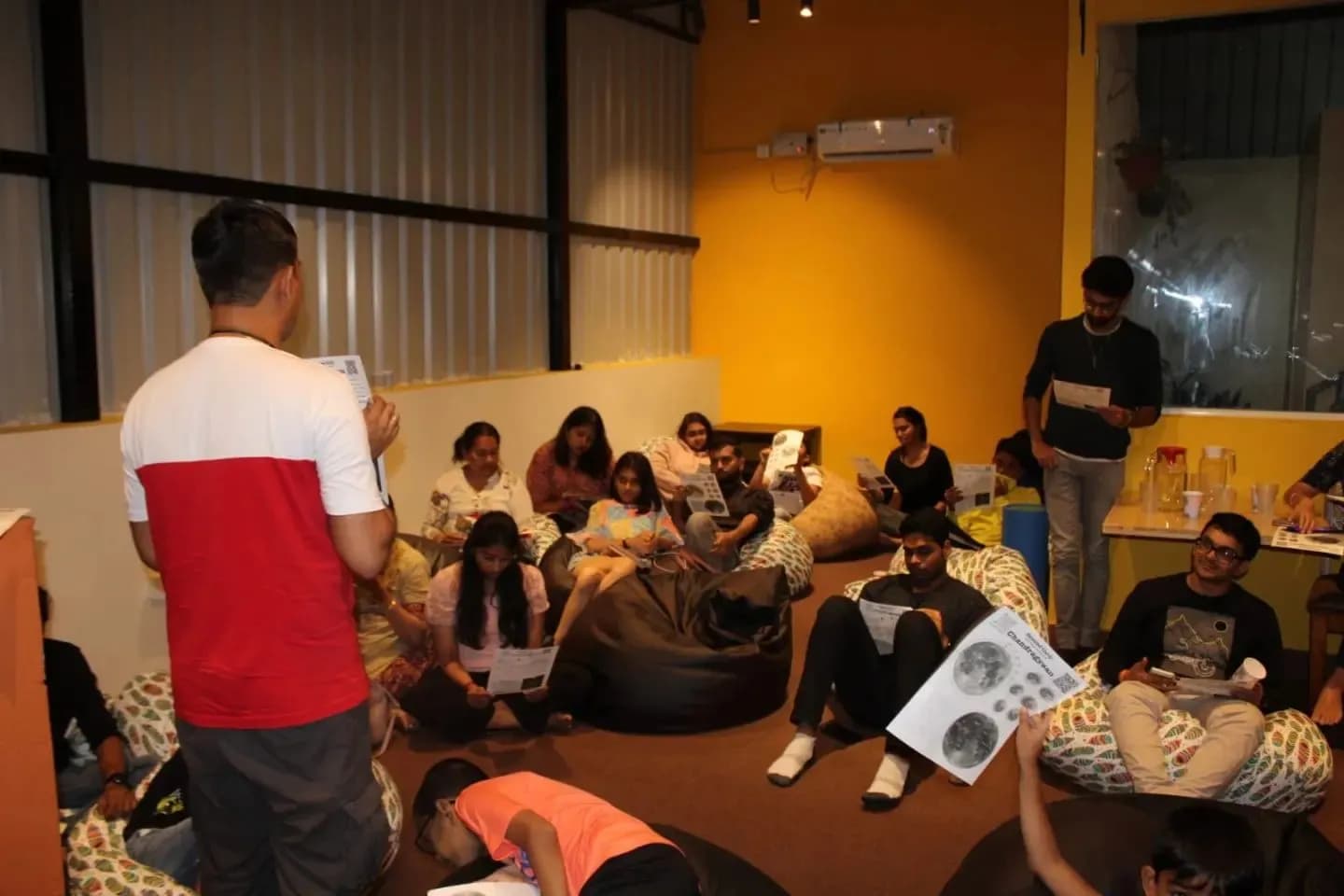
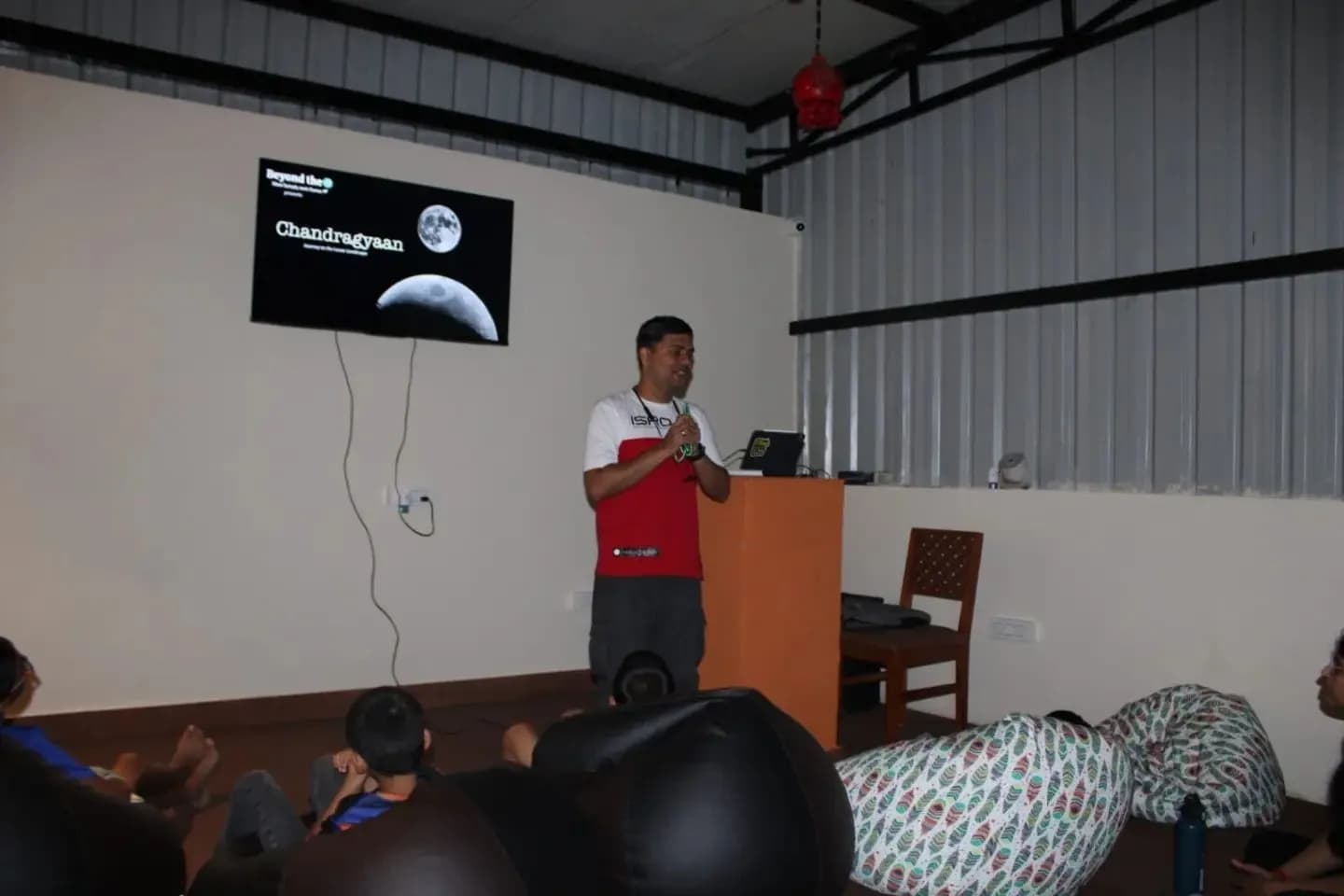
Chandragyaan: Journey to the Lunar Landscape
The Moon up close at Dialogues Cafe, Koramangala, with Moon worksheets and a Chandrayaan-3 simulation, then live online sessions around the launch and on the eve of the landing.
Aug 2023· In person
Udi Udi
The science of flight, with gravity as the villain: the four forces, a Bernoulli paper strip, Newton's third law, and how rockets and countdowns work.
Jan 2024· Talk
Telescope Exploration
How telescopes work, which one to buy (start with binoculars), and how to enjoy Moon-gazing even from the city.
A conversation, not a lecture
A few simple questions each session, and lots of space for kids to ask their own.
Everyday things as science kit
An orange for the Earth, a torch and two balls for eclipses, a party popper for the Big Bang.
The Indian connection
Festivals, calendars, Sriharikota and ISRO: every topic comes back to India and what's next.
Real sky at the end
Telescopes and binoculars out whenever the sky allows, so the ideas meet the real thing.
Book a program
School Astronomy Evenings
Telescopes on your school ground
Chandragyaan: the Moon Program
Everything about our nearest neighbour
Resort and Camp Astronomy Nights
Dark skies, real telescopes
VR Space Sessions
Walk on the Moon in virtual reality
School Space Club
A space club that runs all year
What we bring
- Celestron NexStar 6SE
- Celestron 130EQ
- Seestar S30 smart telescope
- Two portable refractors
- Star projector
- Meta Quest 3 VR headsets
Be first in
Join the waitlist
We'll email you when the first track opens. No spam, and you can ask us to remove you any time.